

The AI Revolution: From Text to Autonomous Agents and Beyond

AI Takes the Wheel: The Rise of Agentic Systems

The world of AI is rapidly changing. We’re moving beyond simple chatbots to powerful “Agentic AI” that can handle entire tasks, from planning marketing campaigns to managing budgets. Imagine AI that doesn’t just draft an email, but executes the whole campaign!
No-Code Agents for Everyone: Companies like Oracle and Asana are making it easier for anyone to build custom AI agents without needing to code, opening up new possibilities for businesses.
AI in Finance: Even financial transactions are getting an AI upgrade, with companies like Visa investing in platforms that allow AI agents to handle payments independently.
AI’s New Frontier: Scientific Discovery & Digital WorldsAI is becoming a partner in scientific research, not just a tool.AI as a Scientist: Google’s “Co-Scientist” and “Empirical Research Assistance (ERA)” are transforming AI into an active collaborator in lab experiments.
Breakthroughs in Biomedicine & Materials: Systems like Microsoft’s AI2BMD are simulating complex biological processes, leading to faster drug discovery, new antibiotics, and quicker development of EV batteries.
Virtual Worlds for Real-World Impact: Platforms like Google DeepMind’s Genie 3 and Nvidia’s Cosmos are creating interactive 3D simulations. These “world models” allow engineers to train robots and predict outcomes safely before real-world deployment.
The AI Engine Room: Hardware & StandardsThe backbone of this AI revolution is also evolving.
Smarter Chips: New computer chip designs are focusing on “memory bandwidth” to overcome AI speed bottlenecks, rather than just raw processing power.
Brain-Inspired & Quantum Power: Engineers are combining AI with “neuromorphic computing” (chips inspired by the human brain) and quantum systems for incredible speeds and lower energy consumption.
Ensuring Responsible AI:Measuring AI Intelligence: The industry is adopting the “Machine Intelligence Quotient (MIQ)” to benchmark AI’s reasoning, speed, adaptability, and ethics.
AI Red Teaming: Governments and businesses are investing in “red teaming” to stress-test AI systems against deception and security threats, ensuring safe and reliable deployment.

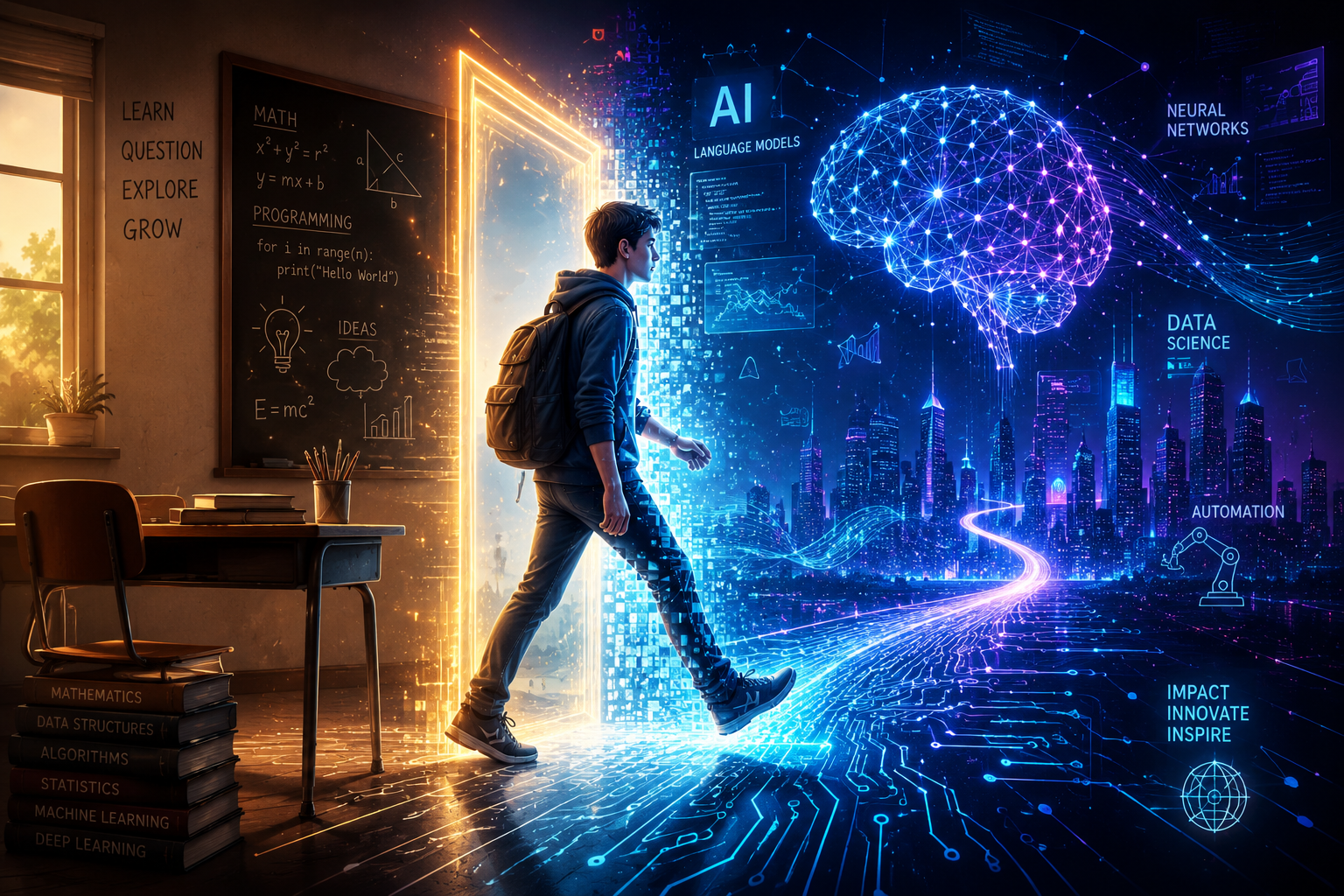
From Classroom to Career: Ultimate Roadmap to Building a Successful Path in AI

1. Build a Strong Foundation in STEM

Mathematics, computer science, and physics form the bedrock of artificial intelligence.

Why it matters: AI algorithms are built on mathematical concepts like linear algebra (for neural networks), calculus (for optimization), and statistics (for data analysis). Without a solid grasp of these, advanced AI concepts become difficult to master.

Key subjects to prioritize:

  • Mathematics: Linear Algebra, Calculus, Probability & Statistics
  • Computer Science: Data Structures, Algorithms, Computational Thinking
  • Physics: Problem-solving and analytical reasoning skills

💡 Pro Tip: Focus on understanding the “why” behind formulas, not just memorizing them.


💻 2. Master the Right Programming Languages

Language Why It’s Important Key Libraries/Frameworks
Python 🐍 The #1 language for AI/ML TensorFlow, PyTorch, scikit-learn, Keras
R 📊 Excellent for statistical analysis caret, randomForest, ggplot2
Java ☕ Used in large-scale enterprise AI Deeplearning4j, Weka
C++ ⚡ For performance-critical AI systems TensorFlow (core), OpenCV

Start with Python — it’s beginner-friendly, has the largest AI community, and offers the most extensive libraries.


📚 3. Understand Core AI & ML Concepts

Dive deep into these fundamental areas:

Concept Description Real-World Application
Machine Learning Algorithms that learn from data Recommendation systems (Netflix, Spotify)
Deep Learning Neural networks with multiple layers Image recognition, speech synthesis
NLP Processing human language Chatbots, translation (ChatGPT)
Computer Vision Teaching machines to “see” Self-driving cars, medical imaging
Reinforcement Learning Learning through trial and error Game AI (AlphaGo), robotics

🛠️ Recommended Learning Resources:

  • Andrew Ng’s Machine Learning Course (Coursera)
  • Fast.ai — Practical deep learning
  • MIT’s Introduction to Deep Learning

🛠️ 4. Gain Practical Experience (This is CRITICAL!)

Theory alone won’t land you a job. Here’s how to build real-world skills:

✅ A. Work on Personal Projects

Start small, then scale up:

  • Beginner: Predict house prices using linear regression
  • Intermediate: Build an image classifier for cats vs. dogs
  • Advanced: Create a real-time object detection app

✅ B. Participate in Competitions

  • Kaggle — The gold standard for data science competitions
  • DrivenData — AI for social good
  • Zindi — Africa’s data science competition platform

✅ C. Secure Internships

Target companies with strong AI teams — tech giants (Google, Microsoft, Meta), startups, or research labs.


📁 5. Build a Killer Portfolio

Your portfolio speaks louder than your resume.

Platform What to Showcase
GitHub Clean, well-documented code repositories
Personal Blog Write about what you’ve learned (like this one!)
LinkedIn Share projects, insights, and achievements
Portfolio Website Showcase your best work with visuals

What makes a great project stand out:

  • Clear problem statement ✅
  • Well-documented code ✅
  • Visual results (graphs, demos) ✅
  • A README explaining your approach ✅

🔄 6. Stay Updated — AI Moves Fast!

The AI field evolves weekly. Stay ahead by:

  • 📰 Following research papers on arXiv.org
  • 📺 Subscribing to Two Minute Papers (YouTube)
  • 🎧 Listening to The AI Podcast (Lex Fridman)
  • 📬 Reading newsletters like The Batch (Andrew Ng), Import AI
  • 👣 Following AI leaders (Yann LeCun, Andrew Ng, Fei-Fei Li) on Twitter/X

🤝 7. Network Like Your Career Depends On It

Because it does! The AI community is welcoming and collaborative.

Method Where to Start
Conferences NeurIPS, ICML, CVPR, AAAI
Meetups Meetup.com, local AI/ML groups
Online Communities r/MachineLearning, AI Discord servers
Hackathons Build projects, meet collaborators
LinkedIn Connect with professionals, share your work

🗣️ “Your network is your net worth.” — Share what you’re learning, ask thoughtful questions, and don’t be afraid to reach out to people you admire.


🎯 Final Thoughts: Your 5-Step Action Plan

Step Action Timeline
1️⃣ Master Python & Math fundamentals Months 1–3
2️⃣ Complete an ML specialization (e.g., Andrew Ng’s course) Months 3–6
3️⃣ Build 3 solid portfolio projects Months 6–9
4️⃣ Enter a Kaggle competition Months 9–10
5️⃣ Apply for internships & entry-level roles Months 10–12